Trinity Striping

ADA Parking Requirements in Florida: What Property Owners Need to Know

ADA parking compliance is not optional — and in Florida, you have two sets of rules to follow. Here's a plain-language breakdown of what your parking lot needs to be fully compliant.

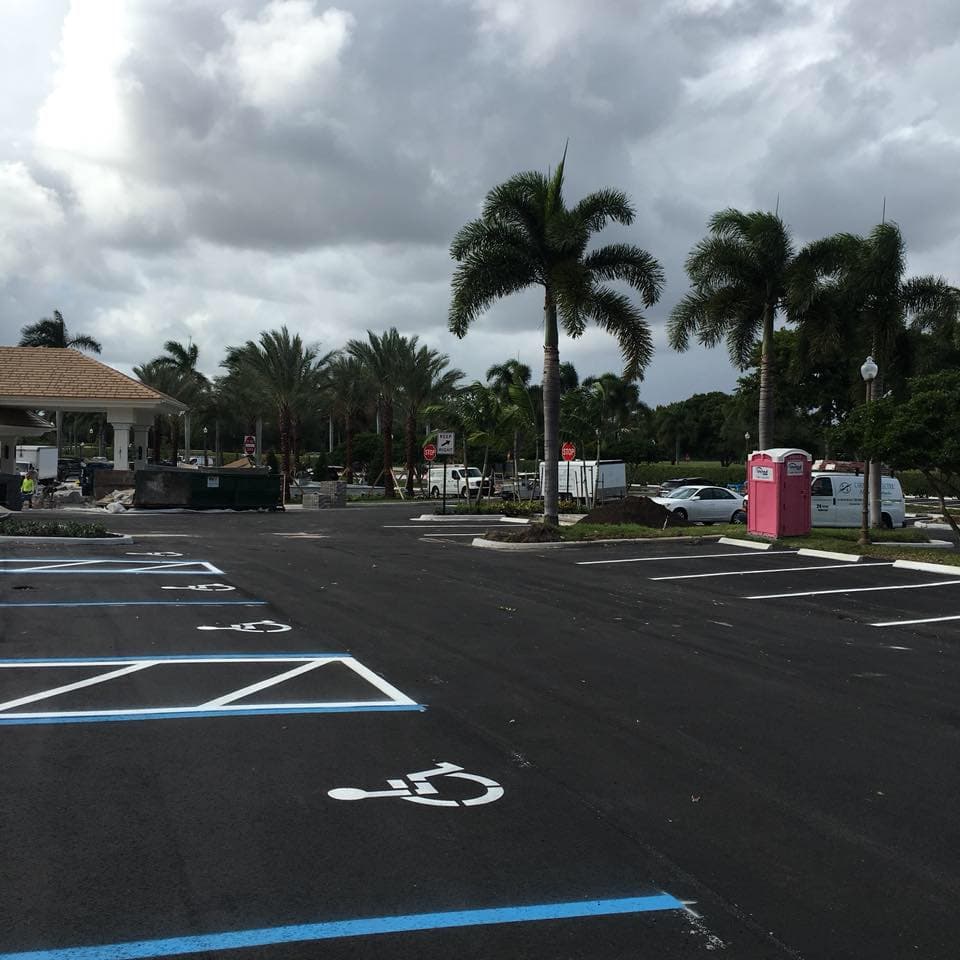
ADA accessible parking space with blue striping, wheelchair symbol, and signage

Two Sets of Rules: ADA and the Florida Building Code

Florida property owners must comply with two frameworks for accessible parking: the federal Americans with Disabilities Act (ADA) Standards for Accessible Design, and the Florida Building Code (FBC). In most cases the requirements are identical, but where they differ, you must meet the stricter standard. For practical purposes, working with an experienced Florida striping contractor familiar with both standards is the safest approach.

How Many Accessible Spaces Do You Need?

The ADA requires a minimum number of accessible parking spaces based on the total number of spaces in your lot. The required ratios are:

  • 1–25 total spaces: 1 accessible space
  • 26–50 total spaces: 2 accessible spaces
  • 51–75 total spaces: 3 accessible spaces
  • 76–100 total spaces: 4 accessible spaces
  • 101–150 total spaces: 5 accessible spaces
  • 151–200 total spaces: 6 accessible spaces
  • 201–300 total spaces: 7 accessible spaces
  • 301–400 total spaces: 8 accessible spaces
  • 401–500 total spaces: 9 accessible spaces
  • 501–1,000 total spaces: 2% of total
  • Over 1,000 total spaces: 20 spaces plus 1 per 100 over 1,000

At least one of every six accessible spaces (or one per lot, whichever is greater) must be van-accessible.

Van-Accessible Spaces: The Requirement Most Lots Miss

Van-accessible spaces are the most commonly overlooked requirement in Florida parking lots. A van-accessible space requires:

  • A minimum 8-foot-wide parking stall
  • An 8-foot-wide access aisle on the passenger side (16 feet total width)
  • Or, a 5-foot access aisle combined with a universal accessible space that is at least 11 feet wide
  • A sign reading "Van Accessible" below the standard wheelchair symbol sign
  • Minimum 98 inches of vertical clearance at the accessible parking space, access aisle, and along the accessible route to the facility entrance

Many older Florida parking lots were built with standard 5-foot access aisles that do not meet the van-accessible requirement. This is one of the most common ADA deficiencies we find during site assessments.

Location: Where Must Accessible Spaces Be?

Accessible spaces must be located on the shortest accessible route to the accessible building entrance they serve. In practical terms, this means:

  • Spaces should be placed near the primary entrance whenever possible
  • The accessible route from the space to the entrance must be free of protruding objects and have a running slope no greater than 1:20 (5%)
  • If a lot serves multiple entrances, accessible spaces should be dispersed to serve each entrance

Many Florida lots have accessible spaces in a convenient location that is technically not on the shortest compliant route — a deficiency that requires relocation of the spaces or construction of a compliant accessible route.

Signage Requirements

Each accessible parking space must be marked with a sign displaying the International Symbol of Accessibility. Signage requirements include:

  • Signs must be mounted with the bottom of the sign at a minimum height of 60 inches above the ground surface
  • Van-accessible spaces require a second sign below the wheelchair symbol reading "Van Accessible"
  • Signs must be visible when a vehicle is parked in the space (not behind the vehicle)

In Florida, parking in an accessible space without a permit is enforced at the state level with fines starting at $250. Clear, properly mounted signage supports enforcement and protects your property from liability.

Surface Markings

In addition to signage, each accessible space must be:

  • Marked with the International Symbol of Accessibility (wheelchair symbol) in the center of the space
  • Outlined with painted borders — typically in blue in Florida
  • Adjacent to an access aisle marked with diagonal stripes
  • The access aisle must be clearly marked as a no-parking zone

For van-accessible spaces, the signage, stall dimensions, and aisle width must all be present and meet the specific van-accessible standards.

What Happens If You're Not Compliant?

ADA parking violations are enforced through civil complaints filed with the U.S. Department of Justice or through private lawsuits. Florida has seen a significant volume of ADA parking litigation in recent years, with some plaintiff firms specifically targeting non-compliant commercial properties. A first complaint can result in remediation orders, legal fees, and potential financial penalties.

The cost of a proper ADA compliance upgrade — adding or relocating spaces, repainting, and installing correct signage — is almost always a fraction of the cost of defending an ADA complaint.

Free ADA Assessment from Trinity Striping

Trinity Striping provides free ADA compliance walkthroughs for commercial properties throughout South Florida. We'll assess your current accessible space count, layout, signage, and access routes — and give you a clear picture of any deficiencies before they become a problem. Contact us at (561) 248-9984 or through our website to schedule your assessment.

Free Quote

Ready to Upgrade Your Parking Lot?

Trinity Striping serves commercial properties throughout South Florida. Call or contact us for a free, no-obligation estimate.

Keep Reading

Related Articles

All Articles